I think I was starving my whole childhood.
I was born in Brooklyn in 1948, the younger child of parents from immigrant Russian Jewish families who had met as counsellors at a summer camp. (She has an older brother named Ken.) My father was a surgeon. My mother was a trained a dietitian, and her attitude toward food shadowed my childhood.
My mother was “obsessed with what she ate,” It was all about nutrition rather than pleasure. She didn’t understand pleasure and as a rule did not serve carbohydrates or dessert. After my father had a heart attack in his forties, cholesterol became forbidden, including cream for coffee. Only skim milk. You might as well pour water in your coffee.
Our family moved to Connecticut when I was five, and though their life appeared to be a model of mid-century suburban prosperity, I experienced it differently. I remember being terrified of my father. My mother maintained a rigid sense of order to avoid my father’s “temper tantrums”—when he’d scream and hit his children. He would just have a rage, where he would drag me around the house by my hair. He never sexually abused me, but he had this love-hate relationship with me. I think he loved me, but he wanted me to be who he wanted me to be, without any consciousness of who I am. At home, I holed up in my room, but at school I let the real me shine. As a teen-ager, I resolved never to date any boy who raised his voice to her.
My truly life began with Jeffrey. We met in 1964, when he spotted me through a library window at Dartmouth, where he was a freshman and I was visiting my brother, Ken, a sophomore. I was sixteen, wearing blue Pappagallo flats bought with my own money and a blue ribbon in my hair.
Jeffery later told me that he could tell by looking at me that she was really smart. I was talking to two people, and he could see the expression on my face. He described it as incredibly alert, even as I was laughing.”
Our relationship developed in letters and on weekend trips. We married when I was twenty and a junior at Syracuse University. In the course of the next decade, I transferred to North Carolina State University and worked a series of short-term jobs; Jeffrey proceeded to the military, to graduate school in international studies, and then to the State Department, where he worked for Henry Kissinger.
My fans know Jeffrey as an uxorious husband who delights in roasted chicken and literally everything else his wife prepares. Our romance has become part of my persona. But, of course, no actual relationship is so easy. My book’s account of a brief separation in the late seventies might surprise some of my readers. Our early dynamic—with Jeffrey as the designated adult—made sense at first, but over time our roles began to chafe, especially amid the broader reconsideration of marriage taking place in the nineteen-seventies. It started to piss me off that I was the only one who made dinner. Our reconciliation involved recognizing that they’d both be happier with more independence.
In the mid-eighties, just as I opened my store in East Hampton and moved there full time, Jeffrey spent two years in Tokyo, overseeing Lehman Brothers’ investment banking in Asia, followed by a year in Hong Kong. By the nineties, “navigating unusual situations was ‘normal’ for us.
In an episode of “30 Rock,” Liz Lemon heralds me as “that woman on the Food Network whose husband only comes home on the weekends, and she spends the rest of the time eating and drinking with her gay friends.” Though marriage saved me from a cold, distant upbringing, it has proven to be remote in another way.
We did not make an explicit choice against parenthood; it was more that parenthood always seemed out of the question to me. I remember thinking very clearly, I don’t know why people have children. I just thought, “Why would you re-create that?” I would be terrified to repeat my childhood. In the early years, Jeffrey would periodically ask whether they should talk about having kids, and I’d demur. And then, at some point, we just didn’t talk about it anymore.
When I was thirty years old, I only worked in jobs I didn’t care about. I’d developed an interest in cooking after a camping trip we had taken in Europe, where I marveled at the goods for sale in French markets, from seasonal produce to jarred pot-au-feu. When we got back, I began cooking my way through Julia Child. I remember going to a dinner party on Park Avenue where guests talked about Lutèce and Craig Claiborne; meanwhile, at the dinner parties I threw in D.C., people talked only about work. To me, it felt very narrow.
I really had no idea what I was getting into. In 1978, I was working in the White House Office of Management and Budget and thinking, I've got to do something more creative and fun than writing nuclear energy budgets! I came across an ad in the New York Times for a specialty food store for sale in the Hamptons and I decided to investigate. My husband Jeffrey and I drove to Long Island the next day to see the store and it was love at first sight. I had no experience in the food business - or in any business! - but I knew that this was exactly what I wanted to do. I made the owner of the store a low offer, thinking I'd go home and decide if I really wanted to make such a dramatic move. The owner called me the next day and said, "I accept your offer!" Yikes! I had just bought a specialty food store!
I soon found that running a store was something like throwing a daily party. My first guests were, in effect, my young employees, a crowd of local high schoolers, college students, and kids whose parents had summer houses nearby. I organized themed costume blowouts (“M*A*S*H”; “Barefoot Olympics”) and accompanied my staff on after-hours skinny-dipping expeditions.
Customers were my guests, too, but they were also the subjects of ongoing research. What inspired them to spend? The trick was to both inspire and satisfy customers’ cravings. After three years, I moved the Barefoot Contessa into a space ten times larger across the street. The new location had white wainscoting and screen doors, like a summer house. Big sacks of coffee beans propped up baskets of fruit; these looked nice, but they weren’t really the point. Coconut cupcakes were the point—along with barbecued ribs, baguettes, and bagels with lox and cream cheese.
After eighteen years of perfecting baguettes and chicken salad, Barefoot Contessa was a hugely popular store celebrated both for its delicious food and its style. In 1996, I decided that it was time for a new challenge, so I sold the store to the manager and the chef. At that point, with nothing to do, I built myself an office over the store and tried my hand at writing a cookbook. The Barefoot Contessa Cookbook came out in 1999 and turned out to be the most exciting thing I've ever done professionally. Happily, that first cookbook was a surprise best-seller. By 2002, I had published two more cookbooks and started filming a show for Food Network, also called Barefoot Contessa.
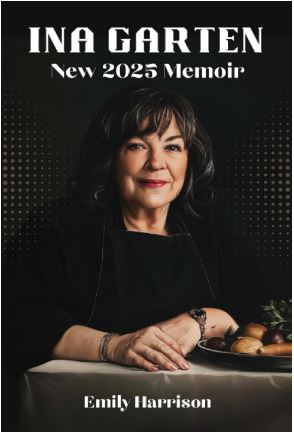
By 2015, I had published nine cookbooks and filmed fourteen years of television shows for Food Network. My new Memoir is available now.
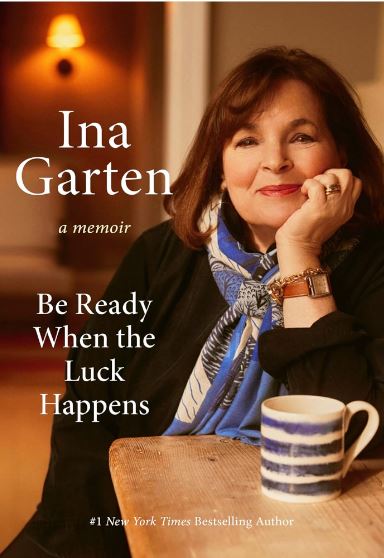
It is a full biography and a testament to my first memoir, Be Ready When the Luck Happens!
I continue to do just that.